30.4.08
Pastel Winds

Nifty article at the Cassini homepage about Saturn's five month storm (the bright smudge in this image). It's nowhere near the scale (or duration) of Jupiter's Red Spot, but it's still thousands of miles across, and somewhat likely to turn your umbrella inside-out.

29.4.08

28.4.08
Further Excitement
No sooner have I blogged the teaser trailer for Mamoru Oshii's upcoming Sky Crawlers, Twitch report that the full length trailer seems to have escaped onto youTube.
27.4.08
White Skies, Fighter Planes

Some unexpected awesome courtesy of Emily Short's IF Cover Art Drive: a lovely cover image for Snowblind Aces, which now also adorns the game's page on this rocketship.
The person responsible is, as yet, a mystery...
Leatherheads
I finally got around to seeing George Clooney's Leatherheads on Friday. I know that a lot of people seemed disappointed by it, and sure, it's no masterpiece, it doesn't push the envelope at all, and it's not as witty as the screwball comedies it emulates - but it's still a very entertaining, very well directed film - and that's all I was looking for.
24.4.08
Prepare to get Excited
Normally it's a bad thing to hear that a director is attempting to make a 'more popular' film, but given how much Mamoru Oshii has been in danger of disappearing up his own backside with his more recent films, it's pretty cool to see that his next project seems to be mostly about blue skies and fighter planes...
23.4.08
Here Be Dragons

Dione - seen here looking especially solid and mysterious - is easily the prettiest of Saturn's grey moons. But it's still difficult to think of a good way to tie it in to St George's Day.
21.4.08
18.4.08

16.4.08
Our Robot Masters
There's a great - and I'm sure some will consider quite provocative - interview with Lord Martin Rees over at the Beeb. I enjoyed Rees' books Our Cosmic Habitat and Just Six Numbers immensely, and I think he's right on the money when he argues that Europe would be better served focusing on unmanned space exploration rather than chasing after costly and - as yet - unproductive manned missions.
That said, my own wishlist for the European Space Agency would focus more on making them like their NASA counterparts. Visiting the website of a NASA mission - Cassini in particular, but others too - you really get the impression that they're trying to be as open and accessible as they can towards the people who funded them (ie. American tax payers), and by happy extension the rest of us too. ESA, on the other hand, is a more distant organisation, and I always double check their image use policy before posting anything they've come up with - even though it was my money that paid for it.
Or perhaps the ESA robots are just less inclined to be generous towards their squishy progenitors.
That said, my own wishlist for the European Space Agency would focus more on making them like their NASA counterparts. Visiting the website of a NASA mission - Cassini in particular, but others too - you really get the impression that they're trying to be as open and accessible as they can towards the people who funded them (ie. American tax payers), and by happy extension the rest of us too. ESA, on the other hand, is a more distant organisation, and I always double check their image use policy before posting anything they've come up with - even though it was my money that paid for it.
Or perhaps the ESA robots are just less inclined to be generous towards their squishy progenitors.
15.4.08
Cassini Extended
I doubt you'll be surprised to learn that Cassini's mission - which technically ended in July - has been extended by two years. It's worth checking out the News Release anyway, though, as it has a number of nifty facts about everyone's favourite space robot.
14.4.08


11.4.08

10.4.08
Telephoto Phobos

My one complaint is that Mars Reconnaissance Orbiter didn't turn its absurdly powerful camera on one of the Martian moons sooner. Presumably some careful conjunction of orbits was required. See the rest of the images here.
Phobos is an almost microscopic 27 km across at its widest point, and orbits Mars in a mere 8 hours. It hugs so close to the equator of its mother planet, that it can't even be seen from higher Martian latitudes.
9.4.08

3.4.08
Potato Beauty

I was going to post this new image of tiny Saturnian moon Janus, since I'm all for improving the visibility - so to speak - of those small irregular moons and asteroids out there. But in the process, I stumbled on this lovely monochrome image of the same moon, as photographed in September 2006. I have to say, I love it when Cassini is able to get these beautifully shadowed images of Saturn's moons in front of their mother planet. You can't help but get a hint of the astronomical sizes and distances involved.
2.4.08
"Gotta find the exit... Gotta find that exit, to Paradise!"

Travis Touchdown, a detached, unemployed loser, proud owner of a
There is some controversy over whether great fountains of blood were inserted into the American version of No More Heroes, or removed from the European and Japanese version - but personally, I can't think of anything more suited to my copy of this game than the way defeated enemies disintegrate into a cloud of black pixels, spurting coins from their severed necks. One of the bravest things that No More Heroes does is unashamedly embrace its gamey-ness.
When every other action game is trying to be the same pseudo-cinematic, over-serious Halo clone, it's nice to see something that's full of beeps and boops, pixellated icons and slacker humour. The characters talk in cartoonish quips, the tone varies on a whim, and those silly little things like 'plot' and 'theme' - while they may be lurking in the background - are happily ridiculed and often sacrificed on the altar of good old-fashioned gameplay. When a useful shopkeeper character dies in the middle of the game, he's still to be found in his old spot, as a ghost, just as able to take your money and provide his services - with hardly a word mentioned about it. No More Heroes is a game that puts more thought into any single instance of slapstick humour than into providing an over-arching sense of emotional progression or resolution. And, hey, why the hell not?
The number one complaint that everyone has with No More Heroes is the attempt to integrate a free-roaming aspect to it. Much of your time in the game takes place in the city of Santa Destroy, driving around its streets on your ridiculously over-sized motorcycle and scouring its alleyways for treasure. And this quickly gets pretty boring. It didn't have to be this way, of course - I've happily spent hours just wandering around Liberty City in GTA3 - but the trouble is that there really are only two things to do in Santa Destroy - drive between established locations and search for treasure. On top of that, the city is completely uninteresting - there are no distinctive building or street designs, no real ambience, hardly any sounds except those of passing cars. If Santa Destroy had any kind of character at all, this free-roaming aspect might actually be pleasant. As it is, it's merely bearable.
Where No More Heroes really excels is in its humorous minigames (trying to work a pump at a petrol station, for example, without setting yourself on fire) and its combat. Great use is made of the wii remote for all these things. In particular, I like the combination of button-bashing to pull off basic attacks and wii-remote waving to perform finishing moves. Still, the battles against hordes of badguys are pretty repetitive, and although they're usually over quite quickly, they do get tiresome after a while.
So, actually, where No More Heroes really really excels is in its boss fights. The ten assassins you have to defeat are all extremely unusual, well-defined characters. The conversations they have with Travis are entertaining enough, but the battles, in which they get up to all sorts of neat tricks, are extremely fun, challenging and more-ish. In particular, I think it's great how the assassins' over-the-top personalities are perfectly integrated into the unique style and ambience of each of these fights. There's the girl who prances around in a pink dress in between trying to brutally beat your brains out with a baseball bat, for example, or the guy who changes into a superhero costume and swoops around a television studio suspended from wires.
So, yes, it's flawed. But that's probably chiefly because this is a game with a strong creative streak, unafraid to take risks. Perhaps the best way to describe No More Heroes is as "Quentin Tarantino meets Super Mario". You'll know if that appeals to you.
31.3.08

29.3.08
A Brief History of Enceladus
The Enceladus Voyeurs
 William Herschel
Italy, 1610. The x-ray glasses that Galileo Galilei ordered from the Netherlands have in fact turned out to be a peculiar device for enlarging that which is distant. Turning his telescope towards Jupiter, Galileo observes its four moons, the first objects in the celestial sphere to conclusively be shown to be revolving around something other than the Earth. Some time later, he briefly takes a peak at Saturn, but - confused by its rings - he decides he'd probably be better off observing those burly men rapidly approaching from the direction of the Vatican.
England, 1789. Filled with pride at his discovery of Uranus (though he would fortunately die before it was finally named), William Herschel aims the world's largest telescope at Saturn and discovers two new moons, later named Mimas and Enceladus respectively. Enceladus, at this point, and for the next couple of hundred years, was known as nothing more than a white dot. Some further study revealed that it was, in fact, a very white dot. Strangely, the human race remained unmoved.
Robot Visitors
 Credit: NASA/JPL/Space Science Institute
During the latter half of the twentieth century, the great robot exodus began: metal creatures leaving the Earth in droves in the hopes of discovering better working conditions. Voyagers 1 and 2, soliciting employment among the rings of Saturn, took the first close-up photos of Enceladus. Postcards revealed a mysteriously smooth, white world, that was also conspicuously embedded in a diffuse and newly discovered ring.
A Moon's Best Friend
 Credit: NASA/JPL/Space Science Institute
As the twentieth century drew to a close, hardier robots with a stronger sense of commitment were sent into space. Rovers crawled over Mars until their wheels fell off, space telescopes went round and round the Earth until they threw up, and one very plucky 'bot was even bashed around by material ejected from Halley's Comet. Chief among these dedicated pioneers was Cassini, a robotic Flash Gordon complete with lantern jaw and Italian-American pizzazz.
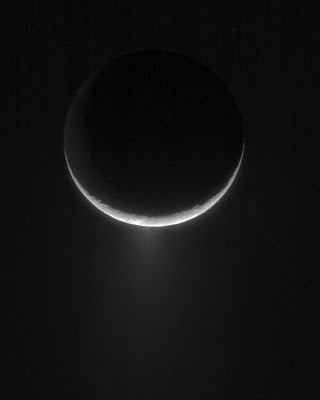
Cassini showed that Enceladus was indeed geologically active, shooting plumes of water ice into space from its south pole. If the complicated mathematics wasn't enough to convince everyone, the photos were. If Enceladus was perfectly snow white, it was because it was coated in perfectly white snow.
What Lies Beneath?
 Credit: NASA/JPL/SwRI
Attempts to explain such activity on a small, cold moon were now a popular topic in planetary science circles. Was this the result of dry, otherworldly chemistry - or was was it due to more familiar mechanisms involving liquid water? One, clearly over-optimistic model suggested that Enceladus might even have warm, sub-surface liquid water, rich in nourishing organic chemicals.
And then, very recently, Cassini dive-bombed the strange tiger-stripe ice formations on Enceladus' south pole, sucking greedily at the rising icy plumes. It sent whispered word back to its friends on Earth, and just this week we learned that the geysers on Enceladus are rich in complex organic chemicals, and the weather among the tiger-stripes is fine (well, relatively speaking, for a world so far from the sun). The question of whether the processes creating these strange geysers is dry or wet remains a mystery, however - and who knows what further mysteries await around the corner from that one?
This is just one of the countless interesting true stories that took place (and continue to take place) out of this world. We notice it especially because it hints at somewhere we might hope to find alien life, and because it is recent. But it's important not to forget the other stories too. When Cassini, Herschel and I get together for drinks, we find it strange that they aren't more widely known.
 William Herschel
Italy, 1610. The x-ray glasses that Galileo Galilei ordered from the Netherlands have in fact turned out to be a peculiar device for enlarging that which is distant. Turning his telescope towards Jupiter, Galileo observes its four moons, the first objects in the celestial sphere to conclusively be shown to be revolving around something other than the Earth. Some time later, he briefly takes a peak at Saturn, but - confused by its rings - he decides he'd probably be better off observing those burly men rapidly approaching from the direction of the Vatican.
England, 1789. Filled with pride at his discovery of Uranus (though he would fortunately die before it was finally named), William Herschel aims the world's largest telescope at Saturn and discovers two new moons, later named Mimas and Enceladus respectively. Enceladus, at this point, and for the next couple of hundred years, was known as nothing more than a white dot. Some further study revealed that it was, in fact, a very white dot. Strangely, the human race remained unmoved.
Robot Visitors
 Credit: NASA/JPL/Space Science Institute
During the latter half of the twentieth century, the great robot exodus began: metal creatures leaving the Earth in droves in the hopes of discovering better working conditions. Voyagers 1 and 2, soliciting employment among the rings of Saturn, took the first close-up photos of Enceladus. Postcards revealed a mysteriously smooth, white world, that was also conspicuously embedded in a diffuse and newly discovered ring.
Could this frigid little ice-ball be geologically active? Is it shooting great gusts of snow into space? How else would its surface be so smooth and crater-free, and where else might this ring come from?
Wish you were here,
Voyager 2
PS. Voyager 1 sends its love.
A Moon's Best Friend
 Credit: NASA/JPL/Space Science Institute
 As the twentieth century drew to a close, hardier robots with a stronger sense of commitment were sent into space. Rovers crawled over Mars until their wheels fell off, space telescopes went round and round the Earth until they threw up, and one very plucky 'bot was even bashed around by material ejected from Halley's Comet. Chief among these dedicated pioneers was Cassini, a robotic Flash Gordon complete with lantern jaw and Italian-American pizzazz.
Cassini showed that Enceladus was indeed geologically active, shooting plumes of water ice into space from its south pole. If the complicated mathematics wasn't enough to convince everyone, the photos were. If Enceladus was perfectly snow white, it was because it was coated in perfectly white snow.
What Lies Beneath?
 Credit: NASA/JPL/SwRI
Attempts to explain such activity on a small, cold moon were now a popular topic in planetary science circles. Was this the result of dry, otherworldly chemistry - or was was it due to more familiar mechanisms involving liquid water? One, clearly over-optimistic model suggested that Enceladus might even have warm, sub-surface liquid water, rich in nourishing organic chemicals.
And then, very recently, Cassini dive-bombed the strange tiger-stripe ice formations on Enceladus' south pole, sucking greedily at the rising icy plumes. It sent whispered word back to its friends on Earth, and just this week we learned that the geysers on Enceladus are rich in complex organic chemicals, and the weather among the tiger-stripes is fine (well, relatively speaking, for a world so far from the sun). The question of whether the processes creating these strange geysers is dry or wet remains a mystery, however - and who knows what further mysteries await around the corner from that one?
This is just one of the countless interesting true stories that took place (and continue to take place) out of this world. We notice it especially because it hints at somewhere we might hope to find alien life, and because it is recent. But it's important not to forget the other stories too. When Cassini, Herschel and I get together for drinks, we find it strange that they aren't more widely known.
28.3.08
A Warm Enceladus Brew

NASA's Cassini spacecraft tasted and sampled a surprising organic brew erupting in geyser-like fashion from Saturn's moon Enceladus during a close flyby on March 12. Scientists are amazed that this tiny moon is so active, "hot" and brimming with water vapor and organic chemicals.
[...]
"Enceladus has got warmth, water and organic chemicals, some of the essential building blocks needed for life," said Dennis Matson, Cassini project scientist at NASA's Jet Propulsion Laboratory in Pasadena, Calif. "We have quite a recipe for life on our hands, but we have yet to find the final ingredient, liquid water[.]"
Read the rest.
Subscribe to:
Posts (Atom)