18.6.11

"So you're still carrying that army .45, Cole."


L.A. Noire is an Important Game. Not, I don't think, because it is itself a masterpiece (except in comparison to previous attempts to do the same thing), but because it points the way to masterpieces that may be made in the future. This is a game that succeeds through its writing, acting and (sometimes second-hand) plotting. The action sequences are often simply less fun than searching crime scenes and interviewing suspects - although I did find the foot chases uniformly thrilling.

It's telling, to me, that the game's biggest problems - a dearth of likeable characters, bystanders who repeat the same quips over and over, and a lack of actual noir-ish sensibility - are all issues with the execution of its story, rather than issues with the mechanics it uses to tell that story in interactive form in the first place. And I was surprised to discover that the last few cases actually fix those three flaws anyway, which makes their existence either more or less of a missed opportunity depending on how you look at it.

For his final assignment at the L.A.P.D., our anti-hero detective Cole Phelps is partnered with Herschel Biggs, nicely played Keith Szarabajka (previously best known for "assuming direct control" in Mass Effect 2). Biggs is the first person Phelps actually seems to almost warm to, even as our protagonist finally crosses the moral event horizon from rude to full fledged bastard - an event which unexpectedly introduces another likeable character and turns the game into a proper jeu noir.

I don't want to spoil anything, but after completing the last three cases I couldn't help but wonder why the game wasn't like that the whole way through. Which, perhaps, does do a disservice to how much I enjoyed the police procedural aspects that made up the meat of the game until that point, but should also speak of how it found something else to do that was arguably more organic and human.

L.A. Noire's other big problem is genre confusion. Not within the game, but within players' expectations. L.A. Noire is set in an impressively detailed recreation of a swathe of late 1940s Los Angeles. In the language of contemporary video games, this implies that it's an "open world game", where you can abandon your objectives and go find fun things to do elsewhere in the city. Which is unfortunate, because there is very little to do in L.A. Noire's city at all, outside of your current case.

It's difficult to judge whether this is a misstep, because the game benefits so much from having this fantastic setting, with huge scope for interesting places to investigate, and endless streets and alleyways through which to chase and tail suspects. If you can unlearn what you've learned about large areas modelled in recent video games (perhaps thinking back to the cities of Syndicate, probably the first game to do this), then the L.A. on show here will suck you in and dazzle you. On the other hand, if you can't help but think of this as an "open world", it will seem almost comically flat, empty and robotic.


Another thing that people might dislike about L.A. Noire but which I thought worked well, is the way you can bumble through cases without really trying. Even if you mess up, other opportunities present themselves, and someone will usually end up in the slammer, if not necessarily the right person. Those who need games to be challenges that must be surmounted through blood, sweat and tears will probably foam at the mouth over this, but I really like it, for two reasons.

Firstly, the most frustrating moment in an adventure game (of which, yes, this is one) is when the whole thing grinds to a halt because you can't solve this one puzzle. It's especially frustrating in a genre historically known for its stories and characters because life doesn't work that way. If you can't find a way to do this one little thing, you're not stuck trying to do it for the rest of your life. You find an alternative way to achieve your goal, or find another goal altogether. L.A. Noire tries to model this, with the proviso that if you can't do things the best way, you'll lose out on a full understanding of the case, and may not even get a conviction out of your arrest.

The second reason I'm fine with L.A. Noire doing this is because it has a little trick up its sleeve called the star rating. At the end of each case you get a stamp with stars on it numbering between one and five. The number of stars you are awarded is basically dependent on how good a detective you are: how many clues you find, how many lies you disprove, how much you don't drive like someone playing a video game (I have problems with that last metric). If you are the right kind of person, the satisfaction of getting five stars is beyond words - as is the shame of getting just one. Of the three cases where I got a one star rating, I replayed two of them immediately - and I'm really looking forward to replaying the remaining one after I've had a little break from 1940s detecting.

Perhaps, finally, L.A. Noire's problem is that it really is that important milestone game, trying to do things that haven't really been done this way before. Because of that, it doesn't know how best to signal its intentions, sowing seeds of confusion among players looking for familiar landmarks. It looks like an open world game, but it's not. It looks like a game about the One Good Cop defeating the bad guys, but it's not.

This is the surprisingly small and personal story of a self-righteous man trying to readjust to civilian life after experiencing traumatic events at war, and the surprisingly small and personal stories of the crimes he investigates as a police officer. In today's market of big budget games, this is unexpected and weird and inevitably not done as well as it could have been. But its success in the video game charts is hopefully a sign to publishers and developers that in this direction lies fertile ground.

16.6.11

Thursday Comic


Batgirl: Kicking Assassins - Andersen Gabrych, Alé Garza, Pop Mhan et al.

Sent by Batman to Gotham's neighbouring city of Blüdhaven, separated from her mentors and friends, Batgirl Cassandra Cain has to face up to some enormous challenges by herself. Yes, of course, there are the usual murderous psychopaths in strange costumes. But even worse for a girl raised from birth to be a merciless killer is the prospect of having to interact with other people at the local coffee shop...

Let me get this out of the way first: the worst thing about this book is the plotting. Maybe I didn't read it carefully enough, but a couple of times I stumbled over what looked to me like out-and-out plot holes. That doesn't matter, though. What Gabrych does do extremely well (aided by some bold artwork) is characterisation. Cassie treads that thin, but compelling and often unexpectedly cute line bordering damaged, dangerous and naive. Alfred is portrayed as protective of her, but confident in her abilities and never patronising. And Cassie's friendship with coffee shop owner Brenda is amusing and touching - the moment where Brenda realises Cassie is illiterate is probably the best in the book.

So, yeah, I really dug this thing, but it still has problems particular to superhero stuff. At one point I realised that something bad had happened to Cassie's close friend Stephanie Brown, so, to get the background, I Googled the answer. "Oh right," I discovered, "it was that." I mean, I knew about it, but how was I supposed to know that this book was from just after that event?

7.6.11

So, superhero comics.

I'll be the first to tell you that DC superhero comics have a problem. Plots spill over from one franchise to another, ostensibly to attract readers between books, but actually just making the stories inaccessible to newcomers and casual readers (of which I might be either the former or the latter); complex mythologies weigh down what should be punchy, action-packed stories; the periodicals take ages to be collected into incomplete, unnumbered books...

So yes, DC, looking to clear out the crap and focus on good, readable stories is exactly what you need to do to turn your fortunes around (especially compared to the kind of head-in-sand thinking you were engaging in a year ago).

But, for fuck's sake, you don't do it by destroying the best character development and backstory you have. Especially not while still leaving in a load of useless cruft.

You don't do it by taking pretty much the only consistently disabled superhero and subjecting her to the most tired and offensive disability trope in speculative fiction.

And most of all, damn it, you don't do it by getting rid of my favourite superhero. ;_;

5.6.11

The Reflexive Engine XI

[Chapter List]

Fission

The birds chirruped happily in the morning light, flitting from branch to branch and plucking cherries with their bony hands. Cathy lay against the tree's gnarled roots, chewing a straw and watching the activity above.

“What is it, Boyo?” she said, without lowering her gaze.

He approached her, cap in hand. “You should come, Cathy. We're in trouble.”

She considered a flippant response about how they were always in trouble, but something about his tone made her think again. “The egg?”

“Just come see.”

*

Joe stood by their wagon, hands on his hips. From beneath his straw hat, his cold blue eyes fixed on Cathy as she looked in the back.

Her first instinct was that they had been robbed. And then she started to understand. The floor of the wagon was littered with wood: axes without heads, knives without blades, muskets without barrels or locks or triggers. And behind all this, glinting in the light of the low sun, were not one, but two golden eggs.

“Now,” Joe said, running a hand over his grey stubble, “you've done a lot of good for this caravan, so I'll let you make the odd mistake. Fact is, we needed those tools and arms.”

“Right. We should keep metal away from it. I mean, them.”

“Tools are one thing, Cathy. Is it safe?”

“I... Yes, I...”

Joe sighed. “Cathy, here's what we're going to do. We're going to tell everyone you got rid of these eggs. And if you have any sense, we won't be lying.”

He pulled down the brim of his hat and walked away. The other people of the caravan glanced furtively at Cathy, trying not to meet her eye.

Boyo said, “It ate the tools.”

Cathy stared at the two golden eggs. “Right.”

“And made another one,” Boyo went on.

“Yeah. It must have.”

“Can it eat wood?”

Cathy closed up the back of the wagon, hiding the eggs from view. “I really, really hope not.”

1.6.11

"One way or another."


Just call me Hypey McHyperson.

30.5.11

Monday Movie: The Station Agent


When Fin inherits a train depot from his only friend, he moves in, hoping to live in solitude. But between the loquacious hot dog vendor who plies his trade nearby, and a clumsy artist keen to apologise for almost running him over (twice), it looks like he's got his work cut out for him.

The Station Agent is a film about a short guy trying not to make friends and failing. It's also, to me, the perfect representation of what I expect from American non-Hollywood movies - slick and good looking, but leisurely paced, with an everyday veracity to its scenes, and overflowing with humanity.

29.5.11

The Reflexive Engine X

[Chapter List]

Travelling Salesman

The horse steadily trotted along the overgrown path, Charlie slumped in the saddle, the professor lying on the cart, propped up on a folded blanket. Here and there, the rolling green hills glinted gold.

The professor sat up. “Do you hear hoofbeats?”

She raised her head, just barely. “Yeah.”

“Should we be concerned?”

“Doubt it.”

Another horse crested the hill behind them at a canter, rode up alongside them and slowed. The smart dandy in the saddle doffed his tricorne. “A very good morning to you.”

The professor glanced at the back of Charlie's head, and followed her lead in remaining silent.

“Allow me to introduce myself,” the dandy continued. “My name's Beau. I'm a... travelling salesman. Perhaps I can interest you in some moth-eaten paper?”

From his overcoat pocket, Beau produced several sheets of paper dotted with neat rectangular holes.

Charlie pulled gently on the reins, and her horse slowed to a stop.

Beau leafed through the bundle. “How much do you suppose this would be worth?”

The professor scrambled down from the cart and ran his fingers through his wild hair. “More than you can imagine.”

“An answer I like,” Beau said. And then he looked the older man up and down, taking in his ragged appearance. “How much do you have on you?”

The professor patted his pockets. “Uh...”

“I see. What a shame.”

Beau spurred his horse on, stopping abruptly a moment later at the sabre barring his path.

Charlie said, “How much is your life worth?”

Beau shrugged. “Depends who you ask, really. Regardless, a price you'd be hard pressed to extract.”

Her sabre blurred through where Beau's neck should have been, if he hadn't suddenly been leaning out of his saddle, pressing a pistol to her side. With a blast of smoke and flame he shot her. Still her blade came down, and Beau tumbled from his saddle to avoid it.

As Charlie dismounted and he scrambled to his feet, she said, “You're fast.”

He spread his hands, producing two loaded pistols in the motion. “And you're bulletproof. What are the chances of us meeting like this? I think a hug is in order.”

She swung at him twice more, and each time he stepped aside with preternatural speed and cat-like grace.

“Should I shoot you again?” he asked. “Or shall we both accept that it's futile for us to fight?”

She let a half-smile form on her wind-blasted features and sheathed her sword. “We need that paper.”

The professor crawled out from beneath the cart, clearing his throat. “I thought it best to let you settle this between yourselves. My friend, you can have untold riches. But only after we follow that code to its source.”

Beau beamed. “A treasure map!”

“In a way,” the professor said. “But the treasure is a puzzle in itself.”

“Or so you would say,” Beau mused. “To maintain your importance once we know where we're going.”

Charlie said, “We?”

“We three,” Beau clarified.

“Please,” the professor said, extending shaky hands. “Let me see those papers.”

Beau drew a long breath through his lips and then exhaled slowly. “I... suppose. As long as I'm now a part of your little treasure syndicate.”

Charlie's face was unreadable. “Sure.”

“Wonderful! And a chance for us to catch up... sister.”

The professor frowned. “You don't look like-”

“We're not,” Charlie said curtly.

“Family in a very modern sense,” Beau said. “Let's get going. We can talk on the way.”

Charlie grimaced.

25.5.11

Farewell Spirit

Image: NASA/JPL/University of Arizona
More info and larger version

It's sad, but not especially surprising that NASA has now officially called time on silent Mars rover Spirit.

What may be surprising is that the image above, captured by the Mars Reconnaissance Orbiter's powerful HiRISE camera, shows the rover's solar panels glinting perfectly in the sunlight, suggesting that lack of power isn't the root of the problem (damage caused by a previous lack of power over winter is probably the next best suspect).

23.5.11

Monday Movie: The King's Speech


"Bertie" is a shy man with a speech impediment. As the younger brother to the heir to the throne, he does have the odd public speaking engagement, but at least he's not going to be king or anything. Actually, having said that... Oh dear. Perhaps an unorthodox, antipodean speech therapist can help?

The King's Speech is an impeccable historical drama charting the unlikely friendship between two men from wildly different backgrounds. Colin Firth's portrayal of an introverted man propelled into overwhelming duty is deservedly Oscar-winning, but the film's also a fantastic ensemble piece, with Geoffrey Rush, Helena Bonham-Carter, Guy Pearce and Michael Gambon all giving engrossing performances, working from a script that breathes life into historical figures without being weighed down by grandeur.

22.5.11

The Reflexive Engine IX

[Chapter List]

Thanks for the Horse

Stepping down from the stagecoach, Beau paused to consider the broken tripod as the rising sun glinted on its golden hide, casting strange patterns of reflected light on the thatched roofs of the village.

The driver peered down at Beau from his perch. “Are you sure, sir?”

He waved the man away. “Yes, yes. I'm more than capable of getting in and out of trouble by myself. Scurry back to civilisation.”

Adjusting his tricorne, Beau ducked into the local inn. Empty, as he'd expected. Just a burly innkeeper and a lot of empty seats.

“Good morning!” Beau announced cheerfully.

The innkeeper regarded his good spirits with unconcealed suspicion.

“I'm looking for the Franke brothers. I understand they've been a bit of a nuisance in these parts lately.” He set his hat down on the bar. “Perhaps I can help in that regard. They've just now become a nuisance to me too.”

The innkeeper shrugged. “Too late, friend. We all pitched in - those of us left and able - and paid someone to get rid of them for us.”

“I see. And anything they might have had with them?”

“She took it.”

“And which way did she go?”

Beau's perfect smile moved the man only to shrug again.

“My good man,” Beau said, “she, whoever she is, is much better able to look after herself than you are.” With a flick of his wrists, he held a pistol in each hand.

The innkeeper raised an eyebrow. “East. She took the east road.”

“Excellent,” Beau said, tossing his hat carelessly onto his head. “Oh, and thanks for the horse.”

As Beau turned to leave, the man said, through clenched teeth, “You'd be better off steering clear of her altogether.”

“Oh?” Beau said. “And why is that?”

“In all my years as a professional soldier, I never saw anyone as good with a sword as she is.”

Beau examined the barrel of one pistol. “Your concern for my welfare is touching, but fire beats steel every time. Cheerio.”

Beau strolled jauntily out into the street. A minute later, the innkeeper sighed as a horse galloped into the distance.

20.5.11

"Cole Phelps, traffic."


So I just bought an Xbox especially for L.A. Noire, my second most expensive recent purchase after my new glasses. (Well, I say "especially" but hopefully I'll find some other stuff to play on it too.) I'm surprised at how big the thing is, and how heavy. When I planned taking it home on the bus I was kind of expecting something more like my friendly little Wii.

Anyway, here's how my first proper case went: first I accused the only witness of lying and she stopped speaking to me. Then, driving away from the crime scene, I crashed straight into a shop front. Getting out to make sure that none of the people who ran away screaming were hurt, I stepped in front of a car and was knocked down. Now confident that no-one was injured (except me) I then got back in my patrol car and proceeded to reverse over the body and fail the case.

Shortly after that, I was promoted to the traffic division.

19.5.11

Thursday Book


The City & the City - China Miéville

When an unidentified woman is found dead in the city of Besźel, Inspector Borlú quickly begins to suspect that this is far from a typical case for the Extreme Crime Squad. For Besźel is a unique place, where the inhabitants must live every day without seeing what's right in front of them. Anyone who breaks this taboo is subject to terrible penalties. Could this murder be tied up in the very nature of Besźel - and the other city?

Okay, this book blew me away. Kafkaesque is probably the most obvious adjective to use to describe it - not Kafkaesque like Brazil, I mean Kafkaesque like, you know, Franz Kafka. But that's not all there is to it, I mean Kafka was this guy who didn't finish much and died young, while this is a carefully planned and plotted book with memorable characters and a strong sense of cause and effect (at least, within its surreal premise). It has these great, obvious, seemingly overwhelming themes, and then it engages with them and files them down with nuance and complication. And, at the same time, it's a crafty crime novel with a fantastic setting.

The City & the City is, in my ignorant opinion, a stonking great work of modern literature - but, just as importantly, it's also a bloody good read.

18.5.11

"She's behind the pillar!"


One of my inspirations while working on Gun Mute was a little Flash rail shooter called Nobuyuki Forces 3 - a fast paced game, full of secrets and unlockables, with a very neatly implemented (if far from original) cover system.

So huzzah and hooray, Nobuyuki Forces 4 has just blasted its way onto the interwebs. It's missing a lot of the things the third game had (although I suspect there's more to it than first meets the eye), but the most obvious improvement is that this one looks pretty sweet compared to the simplistic visuals of previous instalments.

Via Tim.

15.5.11

Pacian's Eurovision 2011 Picks

Wait, stop, they forgot to count my votes!

Okay, for all that I like a multitude of different kinds of stuff, one thing I always disavow any authority on is music. All the same, after watching some of the show and YouTubing the rest, here's how I'm distributing my points:

12 - Moldova
10 - Italy
8 - Germany
7 - Bosnia and Herzgovina
6 - Sweden
5 - Georgia
4 - Hungary
3 - Iceland
2 - Estonia
1 - France

Based on the music videos, you can swap Germany and Italy around, but on the night Raphael Gulazzi pulled out a fantastic live jazz performance, while Lena Meyer-Landrut seemed a bit lost amidst all the light and noise. Hungary has a similar deal - the song itself is a bit mediocre, but Kati Wolf sung her heart out and really sold me on it.

Anyway, here's the hats - I mean, song that got my douze points.

The Reflexive Engine VIII

[Chapter List]

The Skysail

They sat on the gently sloping roof of a cottage, one of the many little dwellings that clung to the sides of the valley. A valley currently occupied – dominated, rather, by the massive skysail.

The vessel's wooden hull blotted out the sun for many of the more rickety homes at the valley's bottom, and though its sails were folded along its sides like the wings of a bird, the sound of the wind riffling through sailcloth was inescapable. The smoke from the furnace that kept its envelope heated was just as pervasive.

“It's a beautiful ship,” the woman said. Dark-haired and dark-eyed, she sat girlishly, with her wineglass in one dainty hand. “But you've yet to set foot on deck?”

The man wore the uniform of a Royal Navy lieutenant. His perfect features were not so much young, as untouched by life, swathed in a halo of short golden curls. “I felt like taking in the village first. All work and no play, as they say.”

She giggled and raised her glass. “To play! May you find escape from your worries, however long it lasts.”

He laughed and raised his own glass. As he swigged back the wine, he didn't notice that the woman drank none of her own.

“What was your name again?” the woman said. “Nicholas Weatherly?”

He set down his glass and leaned back on the roof tiles. “That's me.”

“And you're the new second mate of the HMS Cockatrice?”

He nodded and yawned. “Exciting, isn't it? I feel perfectly exhausted.”

She leant across to kiss his temple. “Close your eyes and sleep a while. The night is still young.”

*

The Cockatrice would soon be underway, and the captain oversaw the loading of the last of her passengers and cargo from the quarterdeck. A stocky man, his left cheek proudly bore the scar of some freebooter's cutlass.

“Cutting it a bit fine, lieutenant,” he quipped, as a young man of uncommon delicacy approached and snapped a perfect salute.

“Sorry sir,” the officer replied, removing his bicorne. His long black hair was tied into a neat ponytail. “Lieutenant Weatherly, reporting for duty.”

The captain was about to rebuke the man further when a sailor blundered past, shooting the lieutenant a strange look that was returned with a frown.

“We seem to have picked up a lot of new crewmen at this stop,” the captain sighed. “So many unfamiliar faces.”

The lieutenant suppressed a smile. “Don't worry, sir. I have absolute confidence in their loyalty.”

12.5.11

Thursday Comic


20th Century Boys, vols 10-13 - Naoki Urasawa

So volume 12 sees Urasawa finally blow the lid on a mystery that has so far been central to the series. And then, reading volume 13, I couldn't help but think, "Wow. This is the book where it all kicks off."

10.5.11

As Promised

Remember I said you'd get a thing?

Here it is.

7.5.11

The Reflexive Engine VII

[Chapter List]

Lakechurch

The sun was only just setting and already the hybrids were abroad, their presence evident from an odd electricity in the air, and howls that were not quite the wind. The wild-haired professor stood anxiously in the doorway of a run-down inn, glancing anxiously down cobbled streets that ran all too quickly past windowless cottages and into open, exposed hills. Half-hidden by the landscape, a massive, golden tripod lay broken on the horizon, weeds warily scaling its armoured hide.

The tall woman rounded a corner and strolled casually towards him.

“Charlie,” he hissed, “come on!”

She maintained the same pace, through the door, with a brief nod to the innkeeper as, musket in hand, he closed and bolted it behind her. “You sure my horse will be safe?” she asked.

The innkeeper let the barrel of his gun rest on his shoulder. The flickering light of the single oil lamp reflected strangely in one of his eyes. “That stable's kept our few draught horses out of harm's way so far, but no, I wouldn't be sure that anyone's safe in this village.”

The two visitors glanced around the empty inn – a few bare tables and only a single barrel behind the bar.

“Why do you even stay here?” the professor asked.

The innkeeper shrugged. “Why does anyone stay anywhere? I'm headed upstairs, where I'll have a better vantage of any trouble.”

They watched him disappear up the stairs, finding his way by memory into sheer darkness.

“It's not straightforward,” the professor said. “Once decoded, the papers will tell us where to go next. Finding them and getting them back will seem trivial compared to the next leg of the journey. We may have to travel over land untouched by humans in decades to reach our goal.”

Charlie peered through cracks in the door, her arms folded. “And then?”

The professor watched her carefully as he said: “And then we have infinite power. And we destroy it before anyone else can have it.”

Her eyes met his briefly. “Huh.”

“Unless,” the professor said slowly, “you want infinite power?”

Perhaps the barest hint of an almost-smile ghosted into existence on her thin lips. She shook her head.

The professor's shoulders slumped. “I'm so tired. It feels like I've been tired for years now.”

She said nothing. Just stood unmoving, leaning against the door frame.

He turned to the stairs. “I'm going to bed. Good night.”

As he began to fumble into the shadows, she said, without turning, “Take the lamp.”

He thanked her, and left her in darkness. After his footsteps had receded, she grabbed a chair and propped it against the wall opposite the door, slouching into it with one hand on the hilt of her sabre.

If she slept, her eyes still flicked open each time claws scratched the cobblestone outside.

4.5.11

Meanwhile, in education...

The University of Lincoln.

2.5.11

Monday Movie: Ip Man


Living a quiet life in Foshan with his wife and son, Ip Man (Donnie Yen) is nevertheless still frequently called on to exercise his incredible prowess at Wing Chun kung fu to sort out petty feuds and public disorder. But the stakes become life and death when China is invaded by Japan, with starving Chinese bandits threatening his friends, and the occupying army trying to draw him into a brutal martial arts tournament.

Yip Wai-Shun's Ip Man combines beautiful cinematography, a lean and efficient script, sublime action direction from Sammo Hung and a rousing score by Kenji Kawai to create one of the best martial arts films of the past few years. The only niggling dissatisfaction is the fact that this slick, nationalistic action film is supposedly based on the life of a real, flesh and blood man.

30.4.11

The Reflexive Engine VI

[Chapter List]

Parts

Molly wasn't feeling it tonight, sitting in The Freak and Harlot, watching the punters mill in before the sun set and the heavy, reinforced door would have to be barred against the outside world. And then a graceful figure slipped inside, and she sat up straight.

She leant forward over the table, letting her flimsy dress slip from one shoulder. “I knew you couldn't stay away, Beau.”

He twisted his handsome mouth into a smile. “Of course not Molly, you know all the gossip.”

She pursed her lips. “Oh.”

He pulled a chair out from beneath a half-unconscious drunk and slid it over to sit down opposite her. “I hear that someone self-destructed quite spectacularly recently. A learned man, or so they say.”

A look of determination lit her eyes. “Men often meet their ruin in this town. Sometimes even under this very roof.”

“Yes, ruined. He gambled away everything he had. And I've found the chance to help the poor bastard - to return something of his that's come into my possession.”

Her gaze drifted from his striking eyes and across the crowded room. The usual bunch of working men, cheap grafties and cheaper whores. Nothing to compare with the fine young gentleman sat opposite her. “You know I'm one of the girls who gives this place its name? You want to know what's freaky about me? I could leave you speechless.”

“I'd wish you every luck with that,” he said. “Many have tried.”

“I don't speak in jest. I've got bits you've never seen before.”

He sighed. “Molly, do you know about this professor or not?”

“Give up on him,” she answered, through gritted teeth. “He owes a debt to the Franke brothers. They took him to sell for parts.”

He slumped into his chair. “Really? What an age we live in!”

“Anyhow,” she said, touching her fingers to her lips, “I did you a favour, so...”

He slapped the table with his palm, making her jump. “In the absence of the whole, pieces will have to do. Where are the Franke brothers making themselves unwelcome these days?”

She stammered for a few seconds. “A little village, 'Lakechurch' or something like that, but-”

“What would I do without you, Molly?” He kissed her cheek, pressed a handful of gold pieces into her palm and shoved his way through the crowd to the door.

Adjusting her hair and secreting the coins into her bodice, Molly glanced at the people around her, trying to hide her embarrassment. “He's an absolute darling, that one,” she managed to say, through her forced smile.

28.4.11

Thursday Comic


Batgirl: Fists of Fury - Various

This is another victory for my local comic book shop. I've been interested in reading some Cassandra Cain as Batgirl stories for quite some time - she's always seemed like a character I'd appreciate - but until now I've not really had the opportunity. Fists of Fury is a collection of miscellaneous Batgirl stories: some stand-alone vignettes, others detailing Cassie's part in larger stories (apparently as opaque to her as to me).

Damion Scott takes the pencil for four of the chapters, drawing in a highly stylish, deformed style that turns Batgirl into a graffiti-esque silhouette flowing around her opponents like liquid shadow. The chapter pencilled by Phil Noto is a lot less interesting by comparison, but he does draw an extremely cute Oracle, which you should know is more than enough to curry my favour. And another chapter is pencilled by an artist who seems to be trying to emulate Scott's style, but in a way that feels like the collision of two artists' weaknesses.

As for Cassandra Cain, well, my instinct was pretty accurate if this book is any indication. It was a bold move to come up with a Batgirl who, in contrast to Barbara Gordon's lighter, fun-loving vigilante, is actually even darker and more serious than Mr No-Fun himself, Batman. The almost mute daughter of an assassin who brutally indoctrinated her into his line of work, Cassandra is frightened of her own capacity to kill and possesses a strangely innocent callousness. On reflection, it's no surprise that the strongest story in this collection is about Cassandra's interactions with the child of a bank robber. You can feel that this Batgirl is desperate to use her skills to help people, but not entirely sure just how to do that.

And then there's her costume, which is inspired in its simplicity, so inescapably bad-ass that even Ed Benes struggled to sexualise her during her brief appearances in Birds of Prey.

So, yes, I did really enjoy Fists of Fury for its star character. But even without that, this book is worth picking up for Damion Scott's art alone, and the chance to see such an atypically kick-ass superheroine rendered in such a confident, equally kick-ass style.

27.4.11

NO ESCAPE


Not even on this blog. Especially not when I had to get off the tube at Green Park, part of which has been turned into a shark cage for the soft-bodied journalists that must dive into the carnivorous ocean that is the public at large.


Anyway, I wondered down there over lunch and, for some reason, when faced with the sea of tourists and journalists swarming around Buckingham Palace in the sunshine, I decided to take a picture of this thing instead.


Because Buckingham Palace is always there, and this thing's new.

I was going to take a photo of the flags along the Mall, but I realised I couldn't do it without winding up in someone else's picture. On which note, in all the coverage of people flocking to the area, if you see a young man in a suit stopping to check the time on his phone, and then walking on with a glance to the side that says, "Oh hey, a television camera." That's totally me.

26.4.11

Q+A

I answered some questions here. Mostly focused on interactive fiction, and my entry to IFComp.

23.4.11

The Reflexive Engine V

[Chapter List]

Once Cracksman's Gang

She wafted into the room and threw herself into the high backed chair opposite the corpulent Cracksman. As she kicked her feet casually onto his desk, the two men in the room stared at her pale ankles. The rhythmic cranking of the mill machinery reverberated up through the floor.

“The job's done?” Cracksman asked, trying to keep his gaze level with her eyes.

She smiled. “Of course.”

He grinned in return. “You're the best, Jez.”

She absently drew her dagger and picked at a nail with the point. “I know.”

Cracksman nodded to the other man, a fellow with the tell-tale lop-sided hunch of a badly done graft. A bulging sack of gold coins was dumped onto the desk before her.

Her smile widened. “By the way,” she said. “I've found an opportunity. A distant opportunity.”

Cracksman frowned. “I see. I must say I'll be sorry to see you leave. It can be hard getting things done around here without you.”

“I think it may be a big job,” she added. “I'd need a gang.”

“Well, if you need any advice,” Cracksman said, “you've only to ask.”

“What I need,” she repeated, “is a gang.”

Cracksman glanced at the lop-sided man.

You have a gang,” she said, slowly.

“We work the town,” he said. “I can't spare anyone for an expedition.”

She slipped her dagger back beneath her overcoat. “What a shame. Especially with your hands on top of the desk, instead of near the carbine you keep strapped beneath it.”

The lop-sided man plunged his hand into his jacket, but she was quicker, a pistol suddenly in each hand.

*

The workers stared at her as she left Cracksman's office. The two gunshots would have been audible even over the rumbling of the mill's water-driven machinery. Those workers larger and less obviously occupied than the others - Cracksman's footpads and thugs - regarded her with special attention.

“Cracksman is dead,” she announced. “I'm in charge now. Does anyone have a problem with that?”

With a bellow of inarticulate rage, a solid slab of a man charged her, fists clenched. And with four quick stabs of her dagger, she pierced each ventricle of his heart.

“Does anyone else have a problem? No? Then we shall be going on a little expedition.”

22.4.11

Friday Christmas Tree Worm Blogging

Image Credit: Nick Hobgood
Some rights reserved
Image source

Just getting into the spirit of the season.

21.4.11

Thursday Book


1920s Britain - Janet & John Shepherd

A slim reference, with little interest in narrative or theory. A nice recap of things I've learned elsewhere.

Really, I just bought it for the pictures.

18.4.11

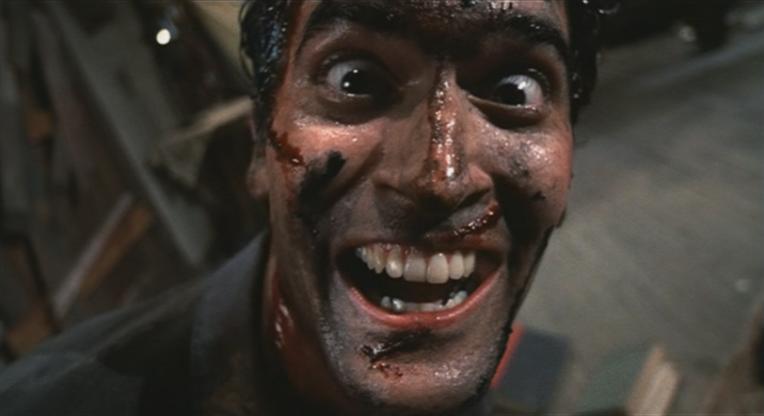
Monday Movie: Evil Dead 2


An isolated rural cabin seems like the perfect romantic getaway for Ash (Bruce Campbell) and his girlfriend Linda - but little do they know that the absent occupants had been dabbling in the occult. When Linda is possessed by a Kandarian demon, Ash (perhaps a bit too readily) decapitates her with a shovel and buries the body. And this is only the start of his ordeal. By the time relatives of the cabin's owners arrive to discover the blood-soaked, unhinged man barricaded inside, it may not be easy for them to accept where the real danger lies...

The first thing that's apparent about Evil Dead 2: Dead by Dawn is the bold and dynamic direction from Sam Raimi, readily lifting this otherwise shaky and low budget film above its B-movie roots. The next thing you'll notice is just how damn funny and scary the film manages to be, often at the same time. The scares come from meticulously crafted shocks and a relentlessly sinister atmosphere. The comedy comes from the slapstick violence, and the absurd situations that develop - both probably exemplified by the sequence in which Ash fights his own possessed hand, before severing it with a chainsaw... at which point he's then forced into a game of cat and mouse with the now independent appendage.

And for all that the film could be claimed to boil down to making you jump out of your seat and split your sides laughing, it does still continue to maintain its atmosphere throughout, constructing a Lovecraft-style mythology of its own, and brutally but steadily fashioning Ash into an iconic horror hero. Add to all that one of my all-time favourite endings to a film, and you've got one heck of a cinematic experience - if you can stomach it.

16.4.11

The Reflexive Engine IV

[Chapter List]

Charlie

She crouched beside an uneven road, sheltering among unkempt trees that bordered neatly tended fields. A tall, broad-shouldered woman, her skin was dusky-toned and her golden-brown hair gathered into a long braid. She wore the white breeches and black coat of some foreign military, a sabre hanging by her side.

Her eyes flicked up at the sound of footsteps and casually - almost lazily - she strode out into the path of three darkly dressed men who led a horse-drawn cart piled high with bric-a-brac.

The foremost of the three removed his tricorn hat and bowed. “Well, hello, Miss. How are you this fine day?”

The other two laughed, hands resting on the butts of holstered pistols.

She stood facing them, feet apart, and spoke quietly. “Turn back.”

The leader looked from one to the other of his lackeys, and all three laughed. “Please,” he said. “The villagers have hired you to protect them, I suppose? They're not worth it, honestly. Take their gold and leave them.”

She placed her hand on the hilt of her sword.

The leader let the reins of the horse fall from his hand. All three men now stood ready to draw their pistols. “There are three of us,” the leader said. “You don't stand a chance.”

A strong breeze whispered across the fields, hissed through the leaves of the trees, and scattered gravel across the road. The woman drew her sword.

Before the foremost man could fire, his arm was severed at the elbow. A split second passed and the tip of the woman's sabre protruded from the back of the man to his left.

The third man fired his pistol with a blast of smoke. A moment later his head was at his feet, his body toppling awkwardly over it.

Clutching his stump, the only man left alive fell to his knees. “He... shot you!”

“Yes,” the woman said. “He did.”

With a flash of silver, all three of the footpads lay dead at her feet.

She approached the horse, and the animal reared up - the whites of its eyes showing, the scent of blood in its nostrils. She caught its reins with a firm, but gentle hand and patted its haunches reassuringly, before turning to the laden cart it was harnessed to.

Something in the pile of bric-a-brac groaned.

With a clatter of displaced trifles, the woman threw back a sheet to reveal an elderly man: wild-haired, gagged and bound. With a few flicks of her sword she cut him free.

“Thank you,” the man gasped, sliding off the cart and rubbing his wrists. “Thank you. Things have been going from bad to worse for me, and I thought they were about to wind up as bad as they could get, if you know what I mean. I can't tell you- Wait, where are you going?”

The woman stopped in her tracks and looked back at him.

“You can handle trouble, right?” he asked.

She nodded. “Yeah.”

“I've lost something,” the man said. “Sheets of paper with holes in them. They don't look like much, but they're worth more than you can imagine.”

“Code?” the woman asked.

“Something like that.”

The woman nodded again and, sabre sheathed, began to walk down the road, drawing the horse along by its reins. The elderly man followed quickly after.

12.4.11

So

I am up to something. I should have a thing done by next week. At least, if I meet my deadline.

So, expect a thing.

9.4.11

The Reflexive Engine III

[Chapter List]

Beau

The windows were shuttered against the daylight, absolute silence prevailing within. Half a dozen men sat around the table, brooding over their cards.

“Your deal, Beau,” said the man with the pointed goatee.

Beau smiled. Unnaturally beautiful, immaculately dressed and, to see the pile of coins in front of him, improbably lucky. He gathered the cards with his perfect hands and began to shuffle.

“Wait,” Goatee said, holding out a hand. “You're quick. I'll give you that.”

Beau tried to look puzzled. “What do you mean?”

The other men at the table glanced at one another. Hands began to slide quietly towards belts that held pistols and daggers.

“I know what you are,” Goatee continued. He tapped a finger to the side of one eye. “I am too. I'd see what you were doing even if you weren't always winning when you dealt the hand.”

“A cheater?” one of the other players snarled.

“We have something very special in store for cheaters,” another added.

“I don't want any trouble,” Beau said, setting down the cards and holding out his hands.

The largest man at the table threw back his chair and leapt to his feet, towering over the others. “Well, you've got it anyway.”

With a sudden jerk of his arms, Beau held a small pistol in each hand. Firing both at the same time, he dispatched two of his opponents in one blast of gunpowder, sliding down from his chair and beneath the table just as the giant's fist ploughed through the space previously occupied by his handsome face.

The next blow overturned the table, clearing the line of fire for the two pistols he had pulled from the back of his belt, one bullet smashing the giant's lantern jaw, the other sending Goatee tumbling through the shuttered window.

The last two men raised their weapons. A fellow with a jagged scar across his face aimed his pistol and fired, only for his target to roll forward at the last moment, dodging the bullet and pulling another pair of pistols from his expensive shoes. As the scarred man wrestled with the pouches of shot and powder in his jacket, the only other man standing was shot through the heart in the act of throwing his knife.

Beau got to his feet and dusted down his breeches, watching the scarred man struggle to reload. “I still have a pistol I haven't fired, you know.”

The scarred man dropped his gun and held up his hands. “Take the money. I won't stop you.”

“Of course I'll take the money,” Beau said. “But I can't get a reputation as a cheater, however deserved it might be. One can only cheat the ignorant, don't you agree?”

The scarred man nodded frantically. “I won't tell anyone.”

Beau sighed and waved his pistol back and forth. “But I'm far too trusting. It's my chief flaw. I really should shoot you.”

“I have something else,” the scarred man said, reaching a trembling hand into his waistcoat.

Beau tutted. “It had better not be a pistol. I really have the advantage here.”

But the scarred man produced several folded sheets of paper and handed them, shakily, to the man holding him at gunpoint.

“Blank,” Beau said. “And full of holes. You have a most peculiar sense of humour.”

“I was playing against a professor of some sort, really down on his luck. He lost everything, and this was all he had to put on the table to try and win it back. He said it was worth a fortune.”

Beau raised a slender eyebrow. “Really? Maybe you're the one who's too trusting. Look, toddle off. And we'll both forget we ever knew one another.”

The scarred man blinked, and then took off like a rocket.

Beau dropped the blank sheets of paper on the floor and righted the table, before sweeping his ill-gotten gains into a large purse. One by one he returned his pistols to his belt, sleeves and shoes.

He sighed. Reloading them all would be such a chore.

About to leave, he stooped down on a whim and picked up the blank pages, holding them up to the light that poured in through the broken shutters. The holes in the pages were neat and orderly: some square, some rectangular.

“A fortune,” he mused.

He half made to throw the pages down again, then stuffed them into his riding coat and strolled outside, pockets jangling.

7.4.11

PUNCH PUNCH KICK


I won't claim to be any good at it, but I'm finding the Streets of Rage Remake pretty fun to play. In particular, for a game that boils down to just walking around punching and kicking people, there's an impressive amount of variety and inventiveness to its branching levels.

Hat tip GameCentral Inbox.

6.4.11

A Rusty Friend


Rain Town, by Hiroyasu Ishida.

Make sure to keep watching after the credits.

Hat tip Twitch.

4.4.11

Monday Movie: 5 Centimetres Per Second


As a thick snowstorm closes in, the young Takaki embarks on an unexpectedly difficult journey to reach his erstwhile schoolmate, long-time pen pal and potential soul mate Akari. When he does eventually reach her, it's a moment of profound romance and intimacy that will overshadow every subsequent relationship he has.

Makoto Shinkai's 5 Centimetres per Second is a sixty minute character study told in three parts, charting Takaki's single perfect moment with Akari, and his inability to recapture the electricity of a love that arguably never really happened outside his head in the first place. The monologue voice-overs that accompany the story are over-earnest, but everything else about the film shows surprising restraint for a portrait of adolescent love. The spoken dialogue is natural, and the ambient sounds blend perfectly with visuals that are simply exquisitely gorgeous. The colours, lighting effects and level of background detail are almost overwhelmingly sumptuous.

My favourite of the three chapters is definitely the second one, in which the monologues are pushed to the back seat and we're introduced to Kanae, an adorably shy and indecisive girl with a terminal crush on Takaki. Compared to the barefaced angst on display in Takaki's two chapters, Kanae's story presents the heartbreak of unrequited love as something almost brave and honourable.

Although 5 Centimetres per Second may stumble, it does so on the road to being a perfect little movie. I definitely understand why Shinkai is seen by many as the next big thing in Japanese animation.

2.4.11

The Reflexive Engine II

[Chapter List]

Jezebel

In shirtsleeves and waistcoats, the two men pored over tattered maps and yellowed books. Little outside their immediate thoughts bothered them. The housemaid thought to open the curtains, letting light in through the ornate, baroque windows, and they noticed only that the words flowed more easily from the page, that their scribbles on the wall-mounted blackboard accumulated more quickly and legibly. The tea she proffered slipped down their throats almost by reflex, and the plates of breakfast were ignored. She stoked the fire, and they merely loosened their collars.

When the stranger entered - a tall woman: pale, dark-haired and dark-eyed - she too went unnoticed. She thanked the housemaid for escorting her in, waiting for the younger woman to leave before removing her bonnet. She watched the two men for a minute or so, observing their frantic work and the way it revolved around the chattering machine in the corner.

And then she reached into the dark overcoat she wore over her loose, high-waisted dress, and retrieved a flintlock pistol, discharging it into the nearest man with a thunderous crack. He spun round, eyes wide, and fell to the floor, dead. The other man stared open-mouthed at the stranger, his train of thought finally derailed.

The stranger drew a second pistol and pulled back the hammer. She glanced suddenly back towards the entrance, expressionless and unreadable. After a split-second's thought, she fired through the door, leaving a neat hole just below the keyhole.

The surviving man lunged for the fireplace, grabbing the poker, but with a flash of metal he had dropped it, and the woman was beside him, the point of a long dagger at his throat.

As she pressed forward, he squeezed back against a wall of books. He spoke quickly, trying to spit out the words before it was too late. “Cracksman sent you, didn't he?”

Still stony-faced, she said, “Of course.”

“There's nothing of value here. Kill me and my debts will never be honoured.”

“Unfortunately for you,” she said, pushing the dagger forward, drawing blood. “I still get paid.”

“I know where to find a massive fortune!” he gasped.

“Shame you couldn't have found it sooner.”

“It only just revealed itself. Let me live, and you can have it. Actually, I can have it too. That's its value.”

She extended a manicured, short-nailed hand and skilfully buttoned up his collar, dagger held steadily all the while. “That noisy machine has something to do with it, doesn't it?”

Perhaps relieved to still be alive, he actually smiled. “Yes, yes it does.”

Her impassive mask cracked, and she smiled back. “Then I don't need you.”

With a jerk of her wrist, blood sprayed over the bookshelves, and the man's body hit the floor.

With a glance at the clattering machine, the stranger strode to the door and opened it. Outside, the housemaid lay gasping on the floor, a hand to her stomach, blood spilling out between her fingers. “I told you to go to into the village and post my letter,” the stranger said. “No good comes of listening at keyholes.”

The girl sobbed with pain. “The letter was blank.”

The stranger sighed. “Of course, the kettle. No good comes of steaming open letters either.” She crouched down beside the girl. “It hurts doesn't it?”

The housemaid nodded, eyes screwed tight.

The stranger slid an arm around her shoulder, drawing her close, kissing her forehead. “Shush. Just bear it a second longer.”

The light from the baroque windows flashed briefly on the blade of her dagger.

*

As she wandered back into the room of the two learned gentlemen, cleaning her dagger with a handkerchief, a bird began to plaintively sing outside.

She sheathed her blade, and laid out her two empty pistols on a writing table, running her fingers contemptuously through the garbled notes laid out upon it. All the while, the chattering machine vomited out a long strip of paper, punching it through with holes.

Her cold, eagle eyes followed the strip's coiling path, watching for patterns.

31.3.11

Thursday Book


Biomega, vols 2-5 - Tsutomu Nihei

The first two volumes of Biomega seem to set the pace for the rest of the series: synthetic human heroes ride around on supersonic motorcycles, blowing the shit out of biomechanical zombies and the masked transhumans responsible for them. At one point in volume two, the series' iconic talking grizzly bear, Kozlov, remarks that there now seem to be no normal human beings left. You might take this for a throwaway acknowledgement of a genre-typical setting, but Nihei has actually shown some measure of development in his world up to this point, and its an omen of things to come.

The third volume sees both hidden fracture lines and unexpected alliances become apparent in the frantic build-up to a massive conflict of post-human ideals. It's clear early on in the story that Nihei isn't afraid to follow strange speculations through to their extreme logical conclusion, and the culmination of this conflict in volume four results in such a stonking great development in the story that I don't want to spoil it, save to say that at one point a hole is blasted right through planet Earth.

But the thing that impresses me so much about this series is that for all its epic scale and unswerving commitment to massive ideas, this is always first and foremost a laconic action comic. Far from being laden with exposition, Nihei often has his characters barrel headlong into the surreal aftermath of a new plot point, only explaining it after the fact. Things which have a visual consistency with the otherworldly logic of the settings are frequently left satisfyingly unmentioned in the dialogue. In this way Biomega manages to be both fast-paced and also surprisingly thoughtful speculative fiction. I'm eagerly anticipating the final volume.

30.3.11

Omnomnomnomnom


Skip to 1:40 for a strangely beautiful 2001-esque take on Asteroids.

26.3.11

The Reflexive Engine

Just trying another little series. I'm going to try and keep each chapter relatively short (I'm aiming for 500 words), and I'm also going to maintain this post as a contents page of sorts.

I: The Golden Egg
II: Jezebel
III: Beau
IV: Charlie
V: Once Cracksman's Gang
VI: Parts
VII: Lakechurch
VIII: The Skysail
IX: Thanks for the Horse
X: Travelling Salesman
XI: Fission

The Reflexive Engine I

The Golden Egg

They clambered up streets strewn with rubble, weaving between the wild plants that spilled out between uneven cobblestones. Ahead, the ragged skyline stretched across the horizon, ruined buildings reaching broken limbs towards the storm clouds above. And either side were the neoclassical façades of long-deserted embassies and galleries, windows broken and door frames empty.

She stopped suddenly, and her brother stumbled clumsily into her back, almost dropping his musket.

“This one,” she said.

He looked the building up and down, trying to catch his breath. He was a big lad - powerful, but too clumsy to keep pace with his lean sister on ground like this. “Are you sure?”

She looked back over her shoulder at him, hair cropped short, almost sexless in her breeches and overcoat. Like the others, he had long since grown used to her once scandalous antics.

“Trust me,” she said, and led him through broken double doors.

Within, weeds broke up through a marble floor scattered with rotting detritus and massive bones. The grey light of the overcast sky broke in through shattered windows and cracks in the ceiling.

“Did there really used to be creatures this huge?” he asked, looking at the bones piled on a nearby pedestal.

She nodded and looked around at the markings on the walls. “Of course. But they were too big to ride. People would have always used horses for that. Come on, this way.”

He followed after her, down a shadowed hallway. It wasn't a thing he could understand - why she could read, or how she did it. But it made her useful. Made the others shut up about her many oddities.

He tripped over something, and looked down, recoiling from the golden arm that lay severed on the ground. “Cathy!”

She whirled around, a hand on the the pistol tucked into her belt. “Boyo,” she sighed, a note of disappointment in her voice that made him flush with shame. “You have to get over this fear. The clockwork men don't move anymore. And they never will.”

She turned and went on. And he followed after, still red, still clutching his musket tight in both hands.

The corridor opened into a room with an arched roof. An overgrown tree pushed in through the window, clouds of dust dancing in the thin beams of light that made it through its branches.

“A dead end?” she asked, surprised.

He looked around. Two golden figures lay together in the far corner, slumped against the wall - clinging to one another. “I don't like this, Cathy. Let's go.”

She looked at the markings on the walls, ran a finger through the years of accumulated dust that covered them. “Wait.”

Her fingers slipped through the dust, and then through the wall - no, not a wall: a thin curtain, hidden in the dust and shadows, closing off an alcove. Brazenly, without caution or care, she yanked it open.

He gasped. His sister fell back, landing on her backside with a thump and throwing up a thick cloud of dust. The room lit up, bright rays shining out from the alcove. From the great golden egg that sat on its pedestal, as large as a person curled up into a ball.

They could both only stare.

“What is it?” he asked, eventually.

“I don't know,” she said. And then: “Valuable.”

He was reluctant to approach it. “It looks heavy. We'll never carry it back.”

She got to her feet, unable to take her eyes off the perfect, radiant shell. “Go back to the caravan, Boyo. Bring a shire horse.”

He stared dumbfounded at the egg, and then tore his eyes away, running back down the corridor, musket slung over his shoulder. His feet clattered and scraped against the marble floor, drumming an irregular rhythm as he passed a closed off room, its door obscured by shadow.

Inside the room, the autotelegram stirred from its decade of slumber and began to quietly tap out a message.

24.3.11

Thursday Comic


Batman: The Long Halloween - Jeph Loeb, Tim Sale

Shrouded in corruption, Gotham City's Falcone crime family seems unstoppable. But three different forces for justice have allied against them: police captain James Gordon, district attorney Harvey Dent, and masked vigilante Batman. And on the opposite side of the law, Catwoman, the Joker and the mysterious new Holiday Killer seem to have it in for the Falcones as well. Faced with the rising tide of Gotham's freaks, kingpin Carmine Falcone decides that his only option is to fight fire with fire...

Compared to his cramped and hyperactive introduction to Hush, Loeb has a lot more room to work in on this book, as well as a much more grounded story. The result is a gripping mystery thriller that's not quite as clever as it thinks it is, but still managed to keep me guessing to the end (even if it does seem to go a twist too far in terms of credibility). Some of the dialogue is pretty weak (every single one of Alfred's lines is painful), but for the most part this is the kind of dark, gritty, street-level story you want from a Batman book.

Tim Sale's art is beautifully stylish, evoking the shadowy aesthetic of a well shot film noir, but it's often loose and not very detailed, which is not really to my tastes. Nevertheless, after reading The Long Halloween, I can easily see why this is an oft-cited source text for Christopher Nolan's Batman movies.

17.3.11

Thursday Comic


Batgirl: Year One - Scott Beatty, Chuck Dixon, Marcos Martin, et al.

You'd think that having the police commissioner as your father would help with a career in law enforcement, but Barbara Gordon finds that her overprotective dad only gets in the way of what she wants to do. Even Gotham City's freaky superheroes won't pay any attention to her talents - at least, until one Halloween when the bat-costumed Babs crosses paths with Killer Moth, a man who wants to be to Gotham's underworld what Batman is to its law abiding citizens.

So you may have noticed that Oracle, a.k.a. Barbara Gordon, formerly Batgirl, is my favourite superhero. That "formerly Batgirl" bit is, of course, one of the many cool things about the character, but I have to say that for me the emphasis is kind of on the formerly. This backwards-looking book, then, could almost be aimed at me, as throughout Batgirl: Year One, a lot of common criticisms of Babs' Batgirl are retroactively countered (isn't she just a cheap knock-off of the main Bat? Why isn't she Batwoman?) Which is nice... if also kind of cheating.

More effective are the nods to her future - the references to oracles are a little heavy-handed, but nifty all the same, and while having Black Canary (seen above, THOK-ing) beam into the story from a space station may set a stark contrast to the brutal realism of Batman: Year One, it's the (somewhat rocky) start to a friendship that will come to underpin Birds of Prey, my superhero comic of choice. Elsewhere, a couple of casual comments about the Joker take on a chilling significance in the wider context.

Probably the strongest thing about the book is the art: bold, colourful and rather cartoony - reminiscent of Bruce Timm's animated character designs. It sets a distinctively Batgirl-ish tone to the book, and probably does more to convey the character of the young Barbara Gordon than the internal monologue that crowds each panel. The story itself has its strong and its weak points, but it does the job: neatly defining Barbara Gordon's adventure-seeking Batgirl, while also quietly scattering the seeds that will grow into a mighty Oracle.

15.3.11

Sweet 'n' Sour Mash-Up


Mind... blown.

The care and attention to detail in this thing are amazing.

Via the GameCentral Inbox.

14.3.11

Monday Movie: The Illusionist


As the music hall gives way to the music concert, a French magician winds up doing a small gig on a remote Scottish island. There he meets a young woman who doesn't seem to realise that he's not the worldly star she takes him for. When she follows him back to London, the conjurer struggles to make ends meet, and keep a smile on her face.

While Sylvain Chomet's earlier Belleville Rendez-vous was a raucous adventure with an undercurrent of bitter realism, The Illusionist takes the opposite tack, telling a melancholy, ordinary story tinged with cartoonish magic. The focus is on emotion over plot, effectively aided by the beautifully detailed animation, but the film perhaps feels a little undernourished as a result.

10.3.11

Thursday Comic


Birds of Prey: Sensei and Student - Gail Simone, Ed Benes, et al.

Black Canary, the Gotham superheroine with the voice of a sonic weapon, is in Hong Kong to visit the death bed of her former martial arts master - a man who was also apparently one of the many tutors of ice cold assassin Lady Shiva. Someone seems too impatient to let nature take its course, however, and their sensei is murdered, leading the two women to form an uneasy partnership in pursuit of the guilty party. Meanwhile, back in Gotham, the USA PATRIOT Act comes calling for Oracle, and, in the absence of Black Canary, she's once again forced to call upon her least favourite vigilante, Huntress.

A few months back a genuine comic book store opened up in my two horse town. I dutifully paid a visit, expecting a decent selection of independent and Japanese comics. I was disappointing to find a range vastly inferior to that in my local bookshop. Later, I went back looking for a couple of specific superhero comics. And I still couldn't find what I was looking for. Instead, I found this: one of the two Gail Simone Birds of Prey collections that I don't already own. Score one, local comic book shop.

This is basically the Birds at their best: a relatively small cast; a focused, character-driven story; and a dearth of the greater excesses of superhero mythology. The typically bright and bold artwork of Ed Benes (who does most, but not all of the pencilling) fits the mood perfectly - even if his penchant for T&A goes spectacularly overboard on some pages. And Simone writes great dialogue: with just a few speech bubbles she can express a compelling and entertaining relationship between even the bitterest of enemies. It all makes me rather happy that the latest issues of Birds of Prey are now back in her capable hands.

7.3.11

Monday Movie: Little Big Soldier


In the aftermath of a brutal battle, only two survivors crawl out of the heaped bodies: a reluctant conscript (Jackie Chan) and a wounded general (Leehom Wang). Seeing the opportunity to collect a reward, the conscript ties up the general and begins dragging him back to his homeland. But he soon finds he has to deal with not just his ruthless and highly trained captive, but also the back-stabbing relatives who want the general dead.

A labour of love that Jackie Chan has been trying to get into production for two decades, Little Big Soldier is a historical odd-couple comedy that manages to branch tentatively into action, tragedy and character drama. It's not perfect by any means, and to say that it's Chan's best film for years probably tells us more about his recent track record than anything else, but this is clearly a story that its creators believed in and wanted to tell, and that kind of enthusiasm is always infectious.

3.3.11

Thursday Book


Above the Snowline - Steph Swainston

In the harsh environment of the Darkling mountains, two almost-human races are competing for territory: the winged and urbane Awians, and the ruthless, uncivilised Rhydanne. Seeing her people driven to starvation by Awian overexploitation, the uncompromising Rhydanne huntress Dellin seeks help from the Emperor and his immortal Circle of paragons. And the Emperor sees fit to call on Jant, whose half-Rhydanne, half-Awian ancestry makes him the only man in the world who can fly.

But selfish, arrogant, and ashamed of his own heritage, it's not clear that Jant is really the right mediator. And, despite Jant's overconfident condescension towards his new charge, is he really the one who's in danger from Dellin? Could she even be the only woman in the world with what it takes to break his hardened, misogynistic heart?

The end of the third novel in Swainston's superlative Fourlands fantasy series featured such a breathtaking, tear-jerking twist that I was absolutely desperate to find out what happened next. And so I must confess I was disappointed to learn that the fourth book was a prequel. A prequel set in a time when our dashing anti-hero is not wrestling with his addiction to a drug that also transports him into the bizarre alternate dimension of the Shift. A prequel set in his backwards homeland rather than the front lines of the Fourlands' war against giant Insects. No addiction, no Shift, no Insects... Is there any meat left on Swainston's premise when you tear out these seemingly vital organs?

The answer, I quickly realised, is, "Yes, don't be stupid." I love these books so much because of Swainston's ability to imagine the most outlandish, out-of-this-world settings and characters and then incorporate them into properly plotted, intricately characterised, convincingly detailed stories. This is an author who can write a scene in which a giant insect tears the wings off a man and leave you wincing at the anatomical veracity she lends not one, but two impossible creatures. The Darkling mountains may be a lot more grounded than the most surreal locations Jant has encountered in the Shift, but this is still a highly imaginative story told with that same unexpected realism.

The characters are all sympathetic, even when they're clearly wrong-headed, and the shifting first person narration allows even minor characters the chance to leave an impression (as well as giving us a chance to see the Fourlands without the added tint of Jant's ego). Emotions flow tangibly from the page, and the darkness is balanced with good humour and wit. Above all, though, this is a book, like the three before it, that throws out any and all genre tropes in favour of telling a damn good story.